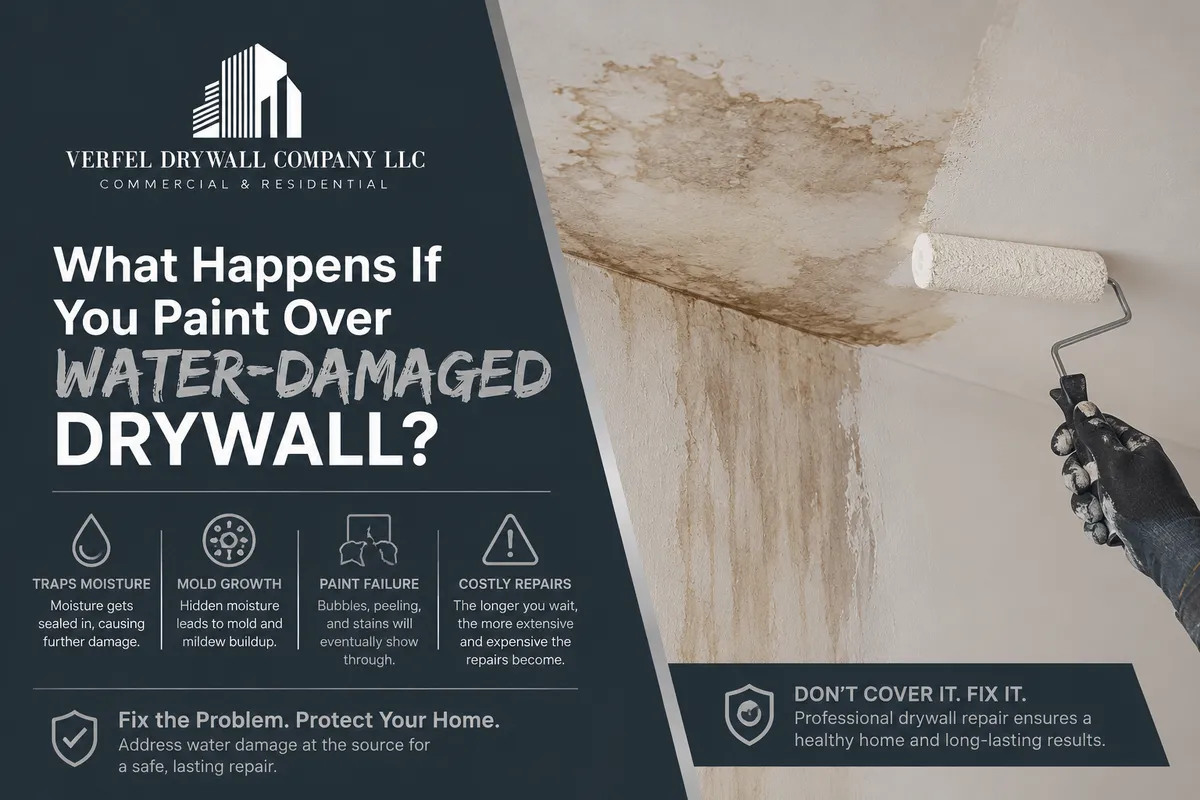
What Happens If You Paint Over Water-Damaged Drywall?
Why This Common Shortcut Always Backfires
It is a tempting shortcut. The ceiling has a water stain, the wall looks a little discolored, and everything seems dry now. A fresh coat of paint will cover it up, and nobody will ever know. This approach is understandable — repairs take time and money, and painting seems fast and straightforward.
But painting over water-damaged drywall without addressing the underlying damage first is one of the most reliable ways to make a moderate problem significantly worse. Here is what actually happens when you skip the repair and go straight to the paint roller.
The Paint Will Not Bond Properly
Water-damaged drywall — even drywall that looks dry — often has a compromised paper facing. The outer layer of drywall is a kraft paper shell, and when it gets wet, the fibers absorb moisture and begin to degrade. Once that paper has been saturated and dried, its surface texture changes in ways that prevent paint from adhering correctly.
The result is paint that bubbles, peels, or flakes within weeks or months of application. In Hawaii's humid climate, this process accelerates. Homeowners in Mililani, Hawaii who have tried to paint over a stain without treating the surface first often find themselves dealing with paint failure that looks worse than the original stain — and that now requires both surface repair and repainting.
Water Stains Bleed Back Through the Paint
Even if the paint adheres initially, water stains have a well-documented tendency to bleed through. The minerals and organic material left behind by evaporated water migrate through standard latex paint over time, leaving a yellow or brown shadow that becomes visible within days to weeks of the fresh coat.
This is why professional contractors apply a stain-blocking primer specifically formulated to seal water stains before any topcoat goes on. Without this primer — and without first confirming the moisture source has been eliminated — the stain will almost certainly reappear regardless of how many coats of paint are applied. Homeowners across Oahu have painted over the same stain two and three times before accepting that primer and proper remediation are the only real solutions.
Mold Can Grow Unseen Behind a Fresh Coat
This is the most serious consequence of painting over water-damaged drywall. If any moisture remains within the drywall or in the wall cavity behind it, mold can develop and spread entirely out of sight. Paint does not seal a surface against mold growth — mold grows on organic material, and drywall paper is exactly that.
In Hawaii's warm, humid environment, mold can establish itself within 24 to 48 hours of sustained moisture exposure. A freshly painted wall may look clean while mold quietly colonizes the backside of the drywall and the surrounding framing. By the time it becomes visible — often as discoloration pushing through the paint or a persistent musty odor — it may have spread well beyond the original stain.
Mold remediation is significantly more expensive than drywall repair. What could have been addressed with a patch and a coat of stain-blocking primer can become a project requiring containment, drywall removal, framing treatment, and air quality testing. For homeowners in Mililani, Hawaii and throughout Oahu, addressing moisture damage promptly and properly is the far more cost-effective path.
The Wall Loses Structural Integrity Over Time
Drywall that has been repeatedly wetted and dried loses the properties that make it useful. The gypsum core provides rigidity and fire resistance, and when it is saturated, it becomes crumbly and soft. A wall that feels firm to the touch on the surface may be significantly degraded behind the paper facing.
Painting over this kind of damage restores none of the panel's structural properties. Screw anchors and hardware installed in compromised drywall will not hold properly. Textures applied over softened material may crack or delaminate more easily. And if the wall is ever opened for plumbing access, electrical work, or future renovation, the hidden damage will be fully exposed — often as a much larger and more expensive project than the original repair would have been.
The Correct Way to Handle Water-Damaged Drywall in Hawaii
Addressing water damage properly involves a clear sequence of steps. Skipping any of them risks a poor outcome regardless of how carefully the finish work is done. Follow these steps in order for a repair that holds up in Hawaii's demanding climate:
Identify and eliminate the source of moisture before any repairs begin. Repairing drywall over an active leak will always fail.
Allow the area to dry completely. Use fans and dehumidifiers to accelerate drying — in Hawaii's humidity, natural drying alone is often insufficient.
Inspect for mold. If mold is visible or suspected, address it through proper remediation before any surface work proceeds.
Remove and replace drywall that is soft, crumbling, or extensively stained. Surface damage only can sometimes be repaired without full replacement.
Apply a coat of oil-based or shellac-based stain-blocking primer to seal any residual staining before painting.
Complete the texture match if applicable, then prime and paint to finish.
Frequently Asked Questions
How can I tell if my drywall is dry enough to paint after water damage?
A moisture meter is the reliable tool for this. Drywall should read below 15 percent moisture content before any repair compound or paint is applied. Relying on touch or visual inspection alone is not sufficient, particularly in Hawaii where ambient humidity can mask ongoing moisture issues.
What type of primer should be used over a water stain?
Oil-based and shellac-based primers are most effective at blocking water stains. Standard latex primer will not reliably prevent bleed-through. Products specifically marketed as stain-blocking primers are formulated for this purpose and should be applied only after the surface is fully dry and mold-free.
Is it ever acceptable to paint over a water stain without making repairs first?
If the stain is old, completely dry, the moisture source has been permanently resolved, and there is no structural softening or mold, a stain-blocking primer followed by paint may be an acceptable cosmetic fix. However, being certain of all those conditions typically requires professional inspection.
Can water damage to drywall be invisible until it becomes serious?
Yes, and this is one of the most important reasons to take any water intrusion seriously early. Damage within the wall cavity — including mold growth on framing members and the back of drywall panels — can be extensive while the visible surface shows only minor discoloration. Hawaii's humid climate accelerates the progression from minor moisture to significant mold growth.
What are the health risks of mold behind painted drywall?
Mold releases spores that can cause respiratory issues, allergic reactions, and other health effects — particularly for children, elderly residents, and those with compromised immune systems. As the mold continues to grow and works its way through the surface, indoor air quality can deteriorate. Professional remediation is the only way to fully resolve the problem.
Conclusion
Painting over water-damaged drywall is a false economy. What appears to be a quick and inexpensive fix almost always creates larger, more expensive problems — peeling paint, persistent stains, hidden mold, and deteriorating wall integrity. The right approach is to address the source of moisture, dry the area completely, remediate any mold, and make proper repairs before any finish work begins.
Verfel Drywall Company LLC has the experience to assess water damage accurately and recommend the right course of action for homeowners across Mililani, Hawaii and the rest of Oahu. If you have noticed water staining or soft spots on your walls or ceilings, do not wait — call (808) 630-0966 for a free assessment.
